
Is It Safe to Drink Boiled Tap Water in Malaysia?
Author: [2026-09-28] | By Xiamen Smart Water Technology Co., Ltd. Allen Huang allen@kitchenwatertap.com
Is It Safe to Drink Boiled Tap Water in Malaysia?
Yes, boiled tap water is generally a safer drinking option than untreated tap water because boiling can inactivate many disease-causing microorganisms. But boiling is not a complete water-treatment process. It does not remove heavy metals, salts, sediments, or most chemical contaminants.
For Malaysian homes, offices, hotels, apartments, and other properties, the more practical question is therefore not simply "Is Malaysian tap water safe?" It is:
What happens to the water between the treatment plant and the glass in your kitchen?
Malaysia has a national drinking-water quality surveillance system, and the Ministry of Health monitors public water supplies against physical, chemical, and microbiological requirements.
At the same time, water quality at the point of use can be affected by the condition of internal plumbing, storage tanks, building infrastructure, and local supply conditions.
That is where a filtered boiling water tap system can make practical sense: filtration addresses contaminants that boiling cannot, while the boiling function provides an additional microbial-control step at the point of use.
Is Tap Water Safe to Drink in Malaysia?
There is no useful one-word answer that applies equally to every Malaysian property.
Malaysia's public water supplies are treated and monitored. The Ministry of Health's National Drinking Water Quality Surveillance Programme covers public water supplies and uses physical, chemical, and bacteriological testing. Its stated purpose is to protect the safety and acceptability of drinking water supplied to the population.
However, water leaving a treatment plant and water coming out of a kitchen faucet are not necessarily exposed to exactly the same conditions.
A building may have:
- Older internal plumbing
- Storage tanks that require cleaning and maintenance
- Sediment accumulated in pipes or tanks
- Temporary discoloration after pipe maintenance or disruption
- Long periods of low or intermittent water use
- Local plumbing conditions that affect taste, odor, or appearance
This distinction is important for anyone evaluating a boiling water tap system for Malaysia.
The public water system is one part of the equation. The building's own water infrastructure is another.
How Does Malaysian Tap Water Reach Your Kitchen?
A simplified route looks like this:
Source → Water Treatment Plant → Distribution Network → Building → Storage Tank → Internal Plumbing → Kitchen Faucet
Water treatment at the public-supply level is designed to control physical, chemical, and microbiological parameters. Malaysian health authorities describe public drinking-water surveillance as covering sampling and assessment of these different categories.
The final section of the journey is much more property-specific.
For example, a condominium, landed house, hotel, restaurant, or commercial kitchen may have different pipe layouts, storage arrangements, water-use patterns, and maintenance schedules.
That is why point-of-use treatment can be useful even when the incoming municipal water is already treated.
What Can Go Wrong Between the Treatment Plant and the Tap?
It is important not to exaggerate these risks. Poor water quality at one building or during one supply event does not mean that Malaysian municipal water is generally unsafe.
But several practical issues can affect point-of-use water quality.
Aging Pipes Can Introduce Sediment
Old or corroded plumbing can contribute rust-colored particles and other sediments.
A household may notice this as:
- Brown or yellowish water
- Visible particles
- Metallic taste
- Temporary discoloration after maintenance
A boiling process does not physically remove these particles.
A sediment or composite filtration stage can be used before the water reaches the heating unit.
Storage Tanks Need Proper Maintenance
In some buildings, water passes through storage tanks before reaching individual apartments or premises.
If a tank is poorly maintained, contaminants can enter or accumulate in the stored water.
This is one reason point-of-use water treatment should consider the complete water path, rather than looking only at the municipal supply.
Intermittent Supply Can Change Local Conditions
Changes in pressure or temporary interruptions can disturb accumulated sediment within distribution or building plumbing.
If water suddenly looks different after maintenance or a supply interruption, it is sensible to follow the instructions issued by the local water supplier or authorities rather than assuming that boiling alone solves every possible contamination problem.
Does Boiling Tap Water Make It Safe to Drink?
Boiling is highly effective against many disease-causing microorganisms, but it does not remove every type of contaminant.
The U.S. EPA states that boiling can kill pathogenic bacteria, viruses, and protozoa, while boiling or disinfection does not destroy heavy metals, salts, and most other chemicals.
The CDC similarly states that boiling is an effective way to kill disease-causing germs, but does not remove chemicals.
So the two processes should not be confused:
| Treatment method | Main purpose | What it does not solve |
|---|---|---|
| Boiling | Inactivates many bacteria, viruses and parasites | Does not remove most chemicals, salts or heavy metals |
| Sediment filtration | Reduces particles, rust and sediment | Does not by itself guarantee microbial safety |
| Activated carbon | Reduces chlorine, odor and some organic compounds | Performance depends on cartridge design and contaminant |
| Membrane filtration | Can reduce selected fine particles and contaminants | Exact performance depends on membrane technology |
| UV treatment | Inactivates microorganisms | Does not remove dissolved chemicals |
| Filter + boiling | Combines filtration with heat-based microbial control | Still requires correct maintenance and suitable filtration |
This is why a filtered boiling water tap can provide a different proposition from a kettle that simply heats untreated tap water.
Does Boiling Remove Heavy Metals From Tap Water?
No.
This is one of the most important points to understand.
The U.S. EPA specifically states that boiling does not remove lead from drinking water.
More broadly, boiling is a disinfection step rather than a general-purpose contaminant-removal process.
If a water source is suspected of containing chemical contamination, the correct response is to identify the contaminant and use a treatment method designed and tested for it. Boiling should not be presented as a universal solution.
For a commercial boiling water tap system manufacturer, this distinction matters. A credible system should clearly separate what the filter is designed to reduce from what the boiling function is designed to achieve.
What Should a Water Filtration System for Malaysian Tap Water Do?
There is no single filter technology that removes everything.
The right configuration depends on the incoming water quality and the contaminants that need to be controlled.
For a household or commercial kitchen, a practical point-of-use system may be designed to address:
| Water-quality concern | Suitable treatment approach | Typical objective |
|---|---|---|
| Rust and visible sediment | Sediment filtration | Reduce particles |
| Chlorine taste and odor | Activated carbon | Improve taste and odor |
| Fine particles | Composite or membrane filtration | Reduce smaller particulates |
| Selected microorganisms | Suitable membrane/UV/thermal treatment | Microbial reduction or inactivation |
| Specific dissolved contaminants | Technology selected for the contaminant | Targeted reduction |
| Microbial risk after filtration | Controlled heating/boiling | Additional microbial-control barrier |
The important word is specific.
A filter should not be marketed as removing a contaminant simply because it contains carbon or a membrane. Performance depends on the cartridge construction, flow rate, contact time, membrane characteristics, installation, maintenance, and independent testing.
Why Combine Filtration With a Boiling Water Tap?
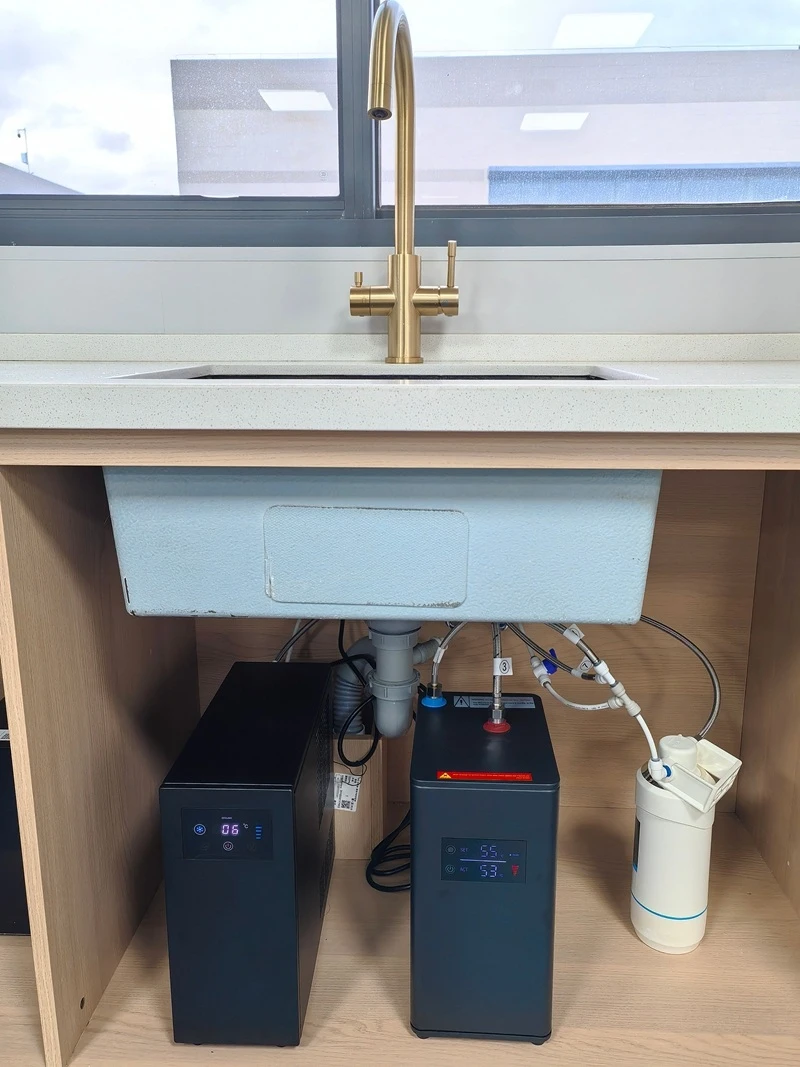
This is where an under-sink boiling water tap system becomes interesting for modern kitchens.
Instead of treating boiling and filtration as competing technologies, they can perform different jobs.
Filtration Comes Before the Faucet
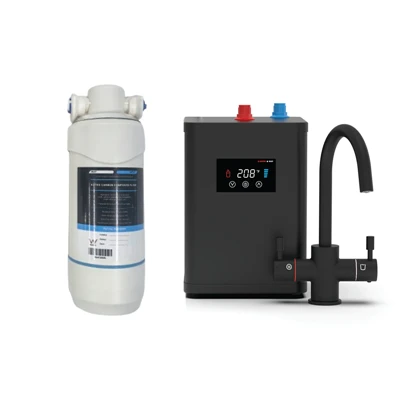
The supplied 2-in-1 system from Xiamen Smart Water Technology combines:
- A multifunctional faucet
- An under-sink boiler
- An activated carbon composite filter
The filtration stage is intended to improve the incoming drinking water before it reaches the dedicated drinking-water pathway.
The Boiler Provides Filtered Boiling Water
The system supplies filtered boiling water through a dedicated waterway.
This creates a simple workflow:
Municipal water → Activated carbon composite filter → Boiler → Dedicated boiling-water outlet
The separate drinking-water pathway also helps distinguish filtered drinking water from the standard mains hot and cold water supplied by the mixer.
Xiamen Smart Water Tech 2-in-1 Boiling Water Tap System
For buyers evaluating a boiling water tap supplier in China, the basic configuration can be summarized as follows:
| Specification | 2-in-1 Boiling Water Tap System |
|---|---|
| System type | Under-sink boiling water tap system |
| Faucet functions | Filtered boiling water + filtered/chilled water |
| Waterways | Two independent waterways |
| Filtration | Activated carbon composite filter |
| Faucet material | SUS304 |
| Cartridge | 25 mm cartridge |
| Boiling-water safety | Child-safety lock |
| Spout feature | Cooling-touch spout |
| Drinking-water application | Point-of-use filtered water |
| Certification/approval information supplied | NSF, CUPC, WRAS, WaterMark |
| Manufacturing model | OEM / ODM |
| Target buyers | Brands, importers, distributors, wholesalers and project suppliers |
Certification note: approvals should always be confirmed against the exact faucet, boiler, filter configuration and destination-market model before a purchase order or regulatory claim is made.
Why the Two Independent Waterways Matter
For a multifunctional kitchen faucet, waterway separation is more than a product-design detail.
The system uses two independent waterways for the drinking-water functions.
One pathway can deliver:
Filtered boiling water
while the other supplies:
Filtered water or chilled water
This architecture allows the filtered drinking-water circuit to remain separate from the ordinary mains hot/cold mixer circuit.
For kitchen brands and plumbing companies developing private-label products, waterway architecture is therefore worth checking alongside the external faucet design.
What Does an Activated Carbon Composite Filter Do?
Activated carbon is commonly used in drinking-water systems to improve taste and odor and reduce chlorine and certain organic compounds.
For a boiling water tap system, the filter is not there simply to make the water "look cleaner."
Its role is to provide a treatment stage before water enters the dedicated drinking-water circuit.
However, filter performance must always be linked to the actual cartridge specification and test data.
For international buyers, a useful supplier checklist includes:
- Filter media composition
- Rated capacity
- Flow rate
- Maximum operating pressure
- Operating temperature
- Replacement interval
- Contaminant-reduction claims
- Independent certification or testing
- Food-contact materials
- Replacement-cartridge availability
That information is much more useful than a generic statement such as "advanced filtration."
Is Boiled Tap Water Better Than Bottled Water?
It depends on what problem you are trying to solve.
Boiling provides a convenient way to control many microbial risks, but it does not remove most dissolved chemical contaminants. Bottled water can provide a controlled drinking-water source, but it creates ongoing purchasing, storage, transportation, and packaging considerations.
A properly designed filtered boiling water tap system combines point-of-use filtration with on-demand hot drinking water.
For homes and commercial kitchens, that can mean:
- No need to boil a kettle every time hot drinking water is required
- Filtered water available directly at the kitchen faucet
- Less dependence on bottled drinking water
- A dedicated drinking-water pathway
- Easier integration into modern kitchen layouts
The actual environmental and operating benefits depend on the system, usage pattern, filter replacement schedule, electricity consumption, and local conditions.
Is Boiled Tap Water Safe for Babies and Young Children?
Extra care is appropriate for infants and other people who may be more vulnerable to infections.
However, boiling should not be treated as a substitute for appropriate water-quality control.
If there is any concern about chemical contamination, boiling will not remove those chemicals.
For infant formula and other sensitive applications, use water from a source that is appropriate for the application and follow the relevant healthcare or public-health guidance.
For a filtration system used by families with young children, buyers should look beyond "filtered water" on the product box and ask for actual performance data and certification applicable to the contaminants of concern.
What Should Malaysian Buyers Look for in a Boiling Water Tap System?
A good system is not simply a faucet with a heater hidden underneath the counter.
For importers, kitchen brands, plumbing companies, and water-treatment businesses, the procurement checklist should include:
| Procurement point | What to verify |
|---|---|
| Waterway design | Separate drinking-water and mains-water pathways where required |
| Filtration | Filter media and tested contaminant-reduction claims |
| Boiler | Capacity, power, temperature range and safety controls |
| Faucet material | SUS304 or specified food-contact material |
| Safety | Child-safety lock and appropriate hot-water protection |
| Spout | Surface-temperature management / cooling-touch design |
| Certifications | Exact model and market-specific approvals |
| Filter replacement | Cartridge availability and service interval |
| Installation | Under-sink space, connections and plumbing requirements |
| After-sales | Spare parts, technical support and warranty |
| Private label | Logo, finish, packaging and engineering customization |
| MOQ | Confirm based on final model and ODM requirements |
For property developers and hospitality suppliers, it is also worth considering serviceability. A system that is difficult to maintain can become an operational headache after installation.
Why an Under-Sink Boiling Water System Makes Sense for Modern Kitchens
The biggest practical advantage is not simply "hotter water."
It is point-of-use control.
The system treats the water where the customer actually uses it: at the kitchen sink.
For a modern kitchen, the basic concept is straightforward:
Filter the drinking water → heat it when required → dispense it directly from the dedicated faucet.
This is particularly relevant to:
- Residential kitchen projects
- Premium apartment developments
- Hotels and serviced apartments
- Office pantries
- Restaurants
- Hospitality projects
- Kitchen furniture manufacturers
- Water filtration brands
- Appliance brands
- Plumbing product distributors
Is a Boiling Water Tap Better Than a Kettle?
The two products solve slightly different problems.
A kettle heats a batch of water when needed.
A boiling water tap system combines filtration, under-sink water heating, and dedicated faucet dispensing into one integrated installation.
| Feature | Traditional kettle | Boiling water tap system |
|---|---|---|
| Point-of-use filtration | Usually no | Yes, depending on configuration |
| On-demand hot drinking water | Yes | Yes |
| Dedicated drinking-water pathway | No | Available |
| Kitchen counter space | Requires appliance space | Main components installed under sink |
| Child safety | Model dependent | Can include safety lock |
| Integration with kitchen faucet | No | Yes |
| Private-label design | Limited | Suitable for OEM/ODM programs |
For a kitchen brand, the second model also opens up opportunities for coordinated faucet finishes, packaging, controls, filter cartridges, and after-sales service.
Xiamen Smart Water Tech as an ODM Boiling Water Tap Manufacturer
Xiamen Smart Water Technology Co., Ltd. develops and manufactures boiling water tap systems and under-sink drinking-water solutions for international markets.
We work with brands and commercial buyers looking for:
- Boiling water tap systems
- Filtered boiling water taps
- Under-sink drinking-water systems
- Multifunction kitchen faucets
- Private-label drinking-water products
- OEM/ODM development
- Distribution programs
- Wholesale supply
- Kitchen and plumbing projects
The company's quality system is based on the supplied ISO9001 and ISO14001 requirements, with product compliance and certification depending on the exact model and destination market.
The supplied product portfolio includes certifications and standards such as UL, CB, CE, GS, ERP, UKCA, RoHS, REACH, WRAS, NSF, KTW and WaterMark, with exact applicability to be confirmed for each model and market.
For an international buyer, that distinction matters: a serious supplier should be able to tell you which approval applies to which product, rather than simply listing certificates on a company page.
The Bottom Line: Is It Safe to Drink Boiled Tap Water in Malaysia?
Generally, boiling treated tap water can make it safer from a microbial perspective, but boiling alone is not a complete drinking-water treatment solution.
Malaysia has a national drinking-water quality surveillance programme, and public water supplies are subject to physical, chemical, and microbiological monitoring.
At the household or building level, however, water can be affected by the condition of storage tanks, internal plumbing, sediment, maintenance work, and other local factors.
The practical approach is therefore:
1. Start with a safe municipal water supply.
2. Understand the condition of the building's plumbing and storage system.
3. Filter the water when additional contaminant reduction is needed.
4. Boil filtered tap water.
5. Maintain and replace filters according to the manufacturer's requirements.
That is the basic engineering logic behind a modern filtered boiling water tap system.
It is not about claiming that Malaysian tap water is universally unsafe. It is about adding another layer of control between the incoming water supply and the glass in your hand.
Frequently Asked Questions
1. Is it safe to drink boiled tap water in Malaysia?
Boiling can inactivate many disease-causing microorganisms, but it does not remove heavy metals, salts, or most chemical contaminants. The actual risk also depends on the water supply and the condition of the building's plumbing and storage system.
2. Does boiling Malaysian tap water remove rust?
No. Boiling does not physically remove rust or sediment. A suitable sediment or composite filter should be used when particle contamination is a concern.
3. Does boiling remove lead from drinking water?
No. The U.S. EPA specifically states that boiling does not remove lead. If lead contamination is suspected, use a treatment method specifically certified for lead reduction and consider testing the water.
4. Does a boiling water tap filter the water?
It depends on the model. The Xiamen Smart Water Tech 2-in-1 system combines an activated carbon composite filter with an under-sink boiler and dedicated drinking-water faucet pathways.
5. Is a boiling water tap the same as a kettle?
No. A kettle heats water in a removable vessel, while a boiling water tap system integrates an under-sink boiler with a dedicated faucet and can incorporate filtration.
6. Why use a filter before boiling water?
Filtration and boiling address different issues. Filtration can reduce selected particles, chlorine, odors, and other contaminants depending on the filter, while boiling provides a heat-based microbial-control step.
7. Is a boiling water tap suitable for Malaysian kitchens?
Yes, provided the system is correctly specified for the local water conditions, electrical requirements, plumbing configuration, installation environment, and applicable Malaysian compliance requirements.
8. What should a distributor check before importing boiling water taps?
Check the exact model's certifications, electrical configuration, waterway design, filter specifications, boiler capacity, safety features, spare parts, warranty, packaging, MOQ, lead time, and availability of replacement cartridges.
9. Can a boiling water tap system be private labeled?
Yes. ODM programs can be structured around faucet design, finishes, branding, packaging, filtration configuration, boiler selection, and other product requirements, subject to engineering and certification review.
10. What certifications should I ask a boiling water tap supplier for?
Ask the supplier to identify the exact certification applicable to the exact model and target market. Depending on the configuration, relevant approvals may include NSF, WRAS, WaterMark, UL, CE, CB, UKCA and other regional requirements.
Talk To A Boiling Water Tap System Manufacturer
If you are an importer, distributor, kitchen brand, plumbing company, water filtration company, appliance brand, hospitality supplier, property developer, kitchen manufacturer, wholesaler, or private-label buyer, Xiamen Smart Water Technology can discuss the product configuration around your market and application.