
What Is a Boiling Water Tap?
Author: [2026-10-04] | By Xiamen Smart Water Technology Co., Ltd. Allen Huang allen@kitchenwatertap.com
A boiling water tap is a kitchen faucet connected to a dedicated under-sink heating tank that stores and maintains hot drinking water, so near-boiling water is available directly from the faucet when you need it.
Instead of filling a kettle, waiting for it to heat, and carrying it to the cup, you simply activate the boiling-water function on the tap.
Depending on the model, a boiling water tap can do much more than dispense hot water. Modern systems can combine boiling, filtered, chilled, mains hot, and mains cold water in one kitchen faucet, with configurations ranging from 2-in-1 to 6-in-1.
For kitchen brands, plumbing companies, water filtration companies, appliance manufacturers, distributors, and private-label buyers, the product is best understood as a complete point-of-use drinking-water system, not just another kitchen faucet.
How Does a Boiling Water Tap Work?
The basic operating principle is straightforward.
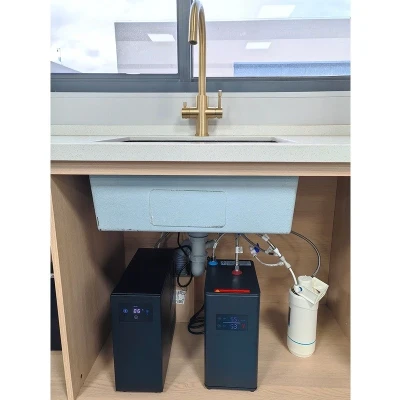
A compact, insulated hot-water tank is installed underneath the kitchen worktop. The tank receives water from the mains supply and heats it to the selected temperature. When the user activates the dedicated boiling-water control, hot water is released through the drinking-water outlet.
As hot water leaves the tank, incoming water replaces the volume used, and the heating system brings the new water back to the preset temperature.
A typical system therefore consists of:
Mains water → Filter → Insulated boiler tank → Dedicated boiling-water waterway → Faucet outlet
The exact architecture varies by model.
Some systems use a mechanical faucet with a mechanical boiler, while digital models use a touch-control faucet connected to a digital boiler tank.
What Temperature Does a Boiling Water Tap Provide?
Many boiling water taps operate close to the boiling point, but the exact output depends on the system design.
Common commercial specifications are around 95–100°C, while some Xiamen Smart Water Tech systems are designed for a maximum output of 98°C.
The important point for buyers is that "boiling water tap" does not necessarily mean the outlet temperature must be exactly 100°C.
| Parameter | Typical Boiling Water Tap Configuration |
|---|---|
| Hot-water output | Approx. 95–100°C depending on model |
| Smart Water Tech maximum setting | Up to 98°C on applicable models |
| Heating method | Under-sink storage/instant hot-water system |
| Installation | Under the kitchen counter |
| Water supply | Mains water |
| Faucet type | Mechanical or digital |
| Filtration | Available depending on configuration |
| Chilled-water function | Available on selected models |
| Sparkling-water function | Available on selected models |
For procurement, always compare the actual rated temperature, recovery time, tank capacity, flow rate, electrical specification, and certification rather than relying only on the phrase "boiling water tap."
Types of Boiling Water Taps
One of the biggest advantages of a modern boiling water tap system is that the buyer does not necessarily need to install a separate hot-water faucet.
A multifunctional faucet can combine several water functions into one product.
2-in-1 Boiling Water Tap
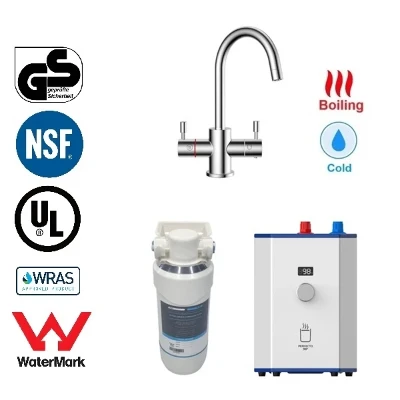
A 2-in-1 boiling water tap generally provides:
- Filtered boiling water
- Filtered water
This is a relatively simple configuration for customers who mainly want filtered drinking water and near-boiling water from one faucet.
3-in-1 Boiling Water Tap
A 3-in-1 boiling water tap combines:
- Boiling water
- Mains hot water
- Mains cold water
This configuration is useful when the buyer wants to replace a conventional kitchen mixer with one faucet while adding a dedicated boiling-water function.
4-in-1 Boiling Water Tap
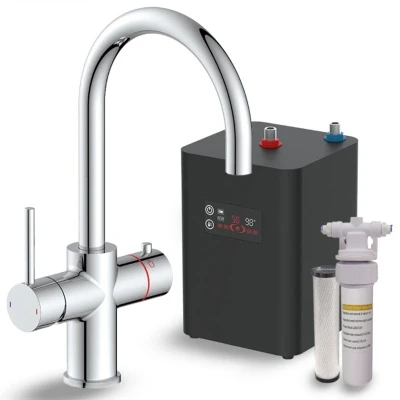
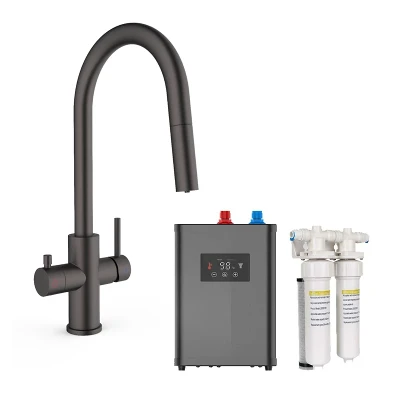
A 4-in-1 system can be configured in different ways depending on the product architecture.
Typical combinations include:
- Boiling water
- Mains hot water
- Mains cold water
- Filtered cold water
Another configuration can replace filtered cold water with chilled filtered water(4 in 1 Boiling Water Tap System).
The exact function combination should therefore be confirmed before ordering.
5-in-1 Boiling Water Tap
A 5-in-1 kitchen faucet can combine:
- Boiling water
- Mains hot water
- Mains cold water
- Chilled water
- Filtered water
Some configurations can instead provide chilled sparkling water as one of the drinking-water functions.
This type of system is particularly attractive for premium kitchens, hospitality projects, and appliance brands looking to combine multiple drinking-water functions in one product.
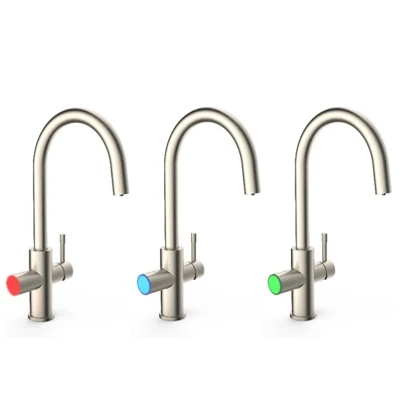
6-in-1 Boiling Water Tap
A 6-in-1 multifunctional water tap can bring together:
- Filtered boiling water
- Mains hot water
- Mains cold water
- Filtered room-temperature water
- Chilled filtered water
- Chilled sparkling water
This configuration turns the kitchen faucet into the central interface for a complete under-sink drinking-water system.
For commercial product development, the exact combination can be adjusted according to the target market, water-treatment architecture, cabinet space, and required certification.
Boiling Water Tap Configuration Comparison
| Tap Type | Mains Hot | Mains Hot | Boiling | Filtered Water | Chilled Water | Sparkling Water |
|---|---|---|---|---|---|---|
| 2-in-1 | - | - | ✓ | ✓ | Optional | - |
| 3-in-1 | ✓ | ✓ | ✓ | - | - | - |
| 4-in-1 | ✓ | ✓ | ✓ | ✓ | Optional | - |
| 5-in-1 | ✓ | ✓ | ✓ | ✓ | ✓ | Optional |
| 6-in-1 | ✓ | ✓ | ✓ | ✓ | ✓ | ✓ |
The exact water functions depend on the final product configuration.
What Are the Main Benefits of a Boiling Water Tap?
A boiling water tap is not simply a replacement for a kettle. Its value comes from combining speed, convenience, filtration, safety, and kitchen integration.
Instant Access to Hot Drinking Water
The most obvious benefit is convenience.
Instead of:
- Filling a kettle
- Waiting for it to heat
- Pouring the water
- Refilling the kettle
the user activates the boiling-water control directly at the faucet.
This is particularly useful when hot water is needed repeatedly throughout the day.
Tea, coffee, instant meals, cooking preparation, and cleaning tasks can all become easier.
Better Control Over Water Quantity
A digital boiling water tap can provide preset water volumes.
This is useful when the user needs a specific quantity rather than boiling a full kettle every time.
For example, a digital system can be configured around predetermined dispensing volumes, depending on the model.
For offices, hospitality environments, and commercial kitchens, repeatable dispensing can also make daily operation more predictable.
Reduced Countertop Appliance Clutter
The boiler tank is installed under the counter.
This leaves the countertop free from a traditional kettle or separate drinking-water dispenser.
For kitchen manufacturers and property developers, this can be an important design advantage because the visible kitchen area remains cleaner and easier to integrate into a premium cabinet design.
Filtration Can Be Integrated
Many boiling water tap systems can incorporate a dedicated water filter.
A filter can help address issues such as:
- Chlorine taste and odor
- Sediment
- Rust particles
- Certain contaminants, depending on the filter technology
The exact performance depends on the filter media, cartridge construction, flow rate, water quality, and certification.
A boiling function and a filtration function should not be treated as the same thing. Boiling is primarily a heat-based treatment step; filtration targets physical and chemical contaminants according to the filter design.
Hot-Water Safety Features
Because these faucets can dispense water at very high temperatures, safety is an important part of the product design.
Common safety features include:
- Child-safety locks
- Two-step activation
- Press-and-hold controls
- Double-click activation
- Cooling-touch spouts
- Insulated components
The exact safety system depends on the model.
For families, hotels, offices, and public-facing installations, buyers should check the actual activation sequence and relevant market safety requirements before selecting a product.
Is a Boiling Water Tap More Efficient Than a Kettle?
There is a practical efficiency advantage because the system provides hot water directly and can dispense only the amount required.
However, it would be misleading to claim that every boiling water tap is automatically cheaper to operate than every kettle.
Energy consumption depends on:
- Tank insulation
- Water temperature
- Ambient temperature
- Standby settings
- Daily usage
- Tank capacity
- Reheating frequency
- Electricity price
- Water temperature entering the system
There is also a higher initial purchase and installation cost compared with a basic kettle.
For commercial buyers, the correct comparison is therefore total cost of ownership, not just electricity consumption.
How Is a Boiling Water Tap Installed?
A boiling water tap requires a permanent connection to the kitchen water supply.
The installation normally requires:
- A suitable faucet mounting hole
- Mains water connection
- Drinking-water filter
- Boiler tank
- Appropriate electrical outlet
- Sufficient under-counter cabinet space
- Drain or safety provisions where required by the tank design
The boiler is normally installed close to the faucet to keep the plumbing run practical.
Typical Under-Sink Installation
Mains water → Filter → Boiler → Boiling-water outlet
For multifunctional models, additional connections may be required for:
Mains hot/cold → Mixer waterways
and:
Chiller → Chilled-water outlet
A professional installation is recommended because the exact plumbing and electrical requirements depend on the model and destination market.
How Much Space Does a Boiling Water Tap Need?
Boiling water taps are available with different tank capacities.
The supplied product range covers systems from approximately 2L to 11L, although smaller tanks are often sufficient for normal residential applications.
| Tank Capacity | Typical Consideration |
|---|---|
| 2–3L | Compact residential applications |
| 4–5L | Higher household usage and many premium kitchen applications |
| 6–8L | Larger demand or commercial applications |
| 9–11L | Higher-volume applications |
The correct capacity should be selected according to expected simultaneous demand rather than simply choosing the largest tank.
A larger tank generally requires more cabinet space.
For a kitchen brand or property developer, cabinet dimensions should be confirmed before the faucet and tank configuration are finalized.
Boiling Water Tap Maintenance: What Needs to Be Replaced?
A boiling water tap requires routine maintenance just like any other drinking-water appliance.
The most important consumable is normally the water filter.
Depending on the model, water quality, filter capacity, and usage, filter replacement may be required every 6–24 months.
For many systems, a practical maintenance interval is around 6–12 months, but the actual replacement schedule should follow the manufacturer's specifications.
| Maintenance Item | Typical Requirement |
|---|---|
| Water filter | Replace according to capacity and manufacturer's schedule |
| Filter housing | Inspect during cartridge replacement |
| Boiler tank | Periodic cleaning/inspection |
| Faucet surface | Clean like a normal kitchen faucet |
| Connections | Inspect for leaks |
| Safety controls | Check during servicing |
| Heating system | Inspect if performance changes |
Hard-water environments may require more frequent attention because mineral deposits can accumulate in the water circuit and heating components.
Mechanical vs Digital Boiling Water Tap
Not every boiling water tap uses the same control technology.
The two main configurations are mechanical and digital.
| Feature | Mechanical Boiling Water Tap | Digital Boiling Water Tap |
|---|---|---|
| Faucet control | Mechanical handle/control | Touch or electronic control |
| Boiler | Mechanical boiler tank | Digital boiler tank |
| Temperature display | Temperature display on boiler tank, none on faucet | Available on applicable models |
| Preset temperatures | Limited/model dependent | Multiple preset options possible |
| Preset water volume | Limited/model dependent | Available on applicable models |
| User interface | Simple physical control | Digital interface |
| Typical positioning | Simple, practical systems | Premium/multifunction systems |
A mechanical model can be attractive where simplicity and cost are the priorities.
A digital system is more suitable when the product needs temperature selection, volume control, display functions, or a more premium user interface.
Faucet Design Options for Different Kitchen Styles
The boiling-water system is hidden under the counter, but the faucet is highly visible.
That makes faucet design an important consideration for kitchen brands and private-label buyers.
Swan-Neck Faucet
The curved spout provides a familiar kitchen profile and generous clearance around the sink.
D-Type Faucet
A D-shaped design creates a cleaner, more architectural appearance and can work well with contemporary kitchens.
Pull-Out Faucet
Pull-out versions provide additional flexibility for washing and rinsing.
Non-Pull-Out Faucet
A fixed spout provides a simpler construction and can be appropriate when the drinking-water function is the primary focus.
Flexible Faucet
A flexible or silicone-hose design can provide additional movement around the sink area.
The final faucet architecture should be selected around the intended application, installation space, target market, and product positioning.
Boiling Water Tap Surface Finish Options
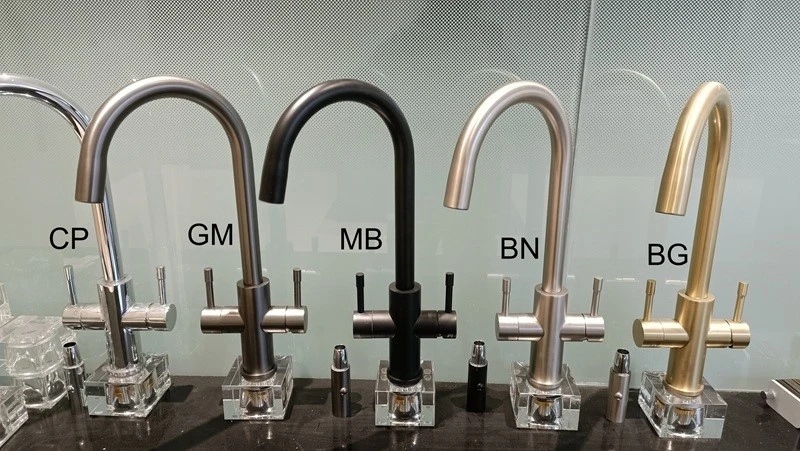
For OEM and private-label programs, the surface finish can be matched to the kitchen's overall design language.
| Code | Surface Finish |
|---|---|
| BN | Brushed Nickel |
| MB | Matte Black Spray |
| GM | Gunmetal Gray PVD |
| CP | Chrome |
| BG | Brushed Gold PVD |
| RG | Rose Gold PVD |
PVD finishes such as Gunmetal Gray, Brushed Gold, and Rose Gold can provide a more premium appearance, while Chrome, Matte Black, and
Brushed Nickel cover more conventional kitchen styles.
The final finish specification should include coating process, substrate, surface requirements, durability testing, and target-market expectations.
What Should You Ask a Boiling Water Tap Manufacturer?
If you are importing or developing boiling water taps, the product specification should go beyond the faucet itself.
Ask the manufacturer for:
| Specification | Why It Matters |
|---|---|
| Tank capacity | Determines hot-water availability and cabinet space |
| Maximum temperature | Defines the actual hot-water performance |
| Heating power | Influences heat-up and recovery time |
| Recovery time | Important for repeated dispensing |
| Flow rate | Affects user experience |
| Filter type | Determines filtration function |
| Filter capacity | Determines replacement frequency |
| Waterway design | Important for drinking-water separation |
| Faucet material | Relevant to durability and water contact |
| Safety system | Important for hot-water protection |
| Electrical requirements | Required for market compliance |
| Certification | Needed for destination-market approval |
| Connection sizes | Required for installation |
| Spare parts | Important for after-sales support |
| Warranty | Affects commercial risk |
| MOQ | Important for procurement planning |
| OEM/ODM capability | Important for private-label development |
One of the easiest ways to start a technical discussion is simply to provide the manufacturer with the filter inlet/outlet size and tap water connector size.
From there, the supplier can evaluate the appropriate waterway, connection, filter, and tank configuration.
Boiling Water Tap OEM and ODM Manufacturing
Xiamen Smart Water Technology Co., Ltd. develops and manufactures boiling water taps, multifunctional kitchen faucets, and under-sink drinking-water systems for international markets.
As an ODM manufacturer, the company can support different product configurations instead of forcing every customer into one standard faucet.
Potential OEM/ODM options include:
- Faucet shape
- Faucet finish
- Mechanical or digital control
- Boiler capacity
- Boiler type
- Filter configuration
- Chilled-water integration
- Sparkling-water integration
- Waterway design
- Branding
- Packaging
- Electrical configuration
- Installation accessories
This is particularly relevant to importers, distributors, kitchen brands, plumbing companies, water filtration companies, appliance brands, hospitality suppliers, property developers, kitchen manufacturers, wholesalers, and private-label buyers.
The right configuration depends on the target market, required functions, cabinet space, water quality, electrical standard, certification requirements, and expected order volume.
International Standards and Product Quality
Xiamen Smart Water Technology places product quality at the center of its manufacturing process and operates according to the company's supplied ISO9001 and ISO14001-based quality requirements.
Its product portfolio includes international standards and certifications such as:
UL, CB, CE, GS, ERP, UKCA, RoHS, REACH, PAHS, SCCP, BSMI, Safety Mark, RCM, WRAS, NSF, KTW, and WaterMark.
Certification should always be checked against the exact product model, configuration, component and destination market.
For a boiling water tap system, buyers should pay particular attention to certification covering:
- Electrical safety
- Drinking-water contact materials
- Faucet construction
- Boiler/tank safety
- Filtration components
- EMC requirements
- Energy requirements
- Local plumbing requirements
This is especially important when a faucet, boiler, filter, and chiller are supplied as one integrated system.
Who Uses Boiling Water Taps?
Boiling water taps are increasingly relevant to applications where convenient hot drinking water needs to be available without a separate kettle.
Typical applications include:
- Residential kitchens
- Premium apartments
- Office kitchens
- Hotel rooms and hospitality areas
- Restaurants
- Tea and coffee stations
- Property developments
- Kitchen furniture projects
- Water filtration systems
- Appliance product lines
For commercial projects, the system should be selected according to expected usage volume, installation environment, maintenance access, electrical requirements, and local certification.
Why Choose Xiamen Smart Water Tech for Boiling Water Taps?
Xiamen Smart Water Technology is focused on the complete drinking-water system rather than the faucet shell alone.
The product range covers:
- 2-in-1 boiling water taps
- 3-in-1 kitchen taps
- 4-in-1 multifunctional taps
- 5-in-1 water taps
- 6-in-1 multifunctional water taps
- Digital boiling water taps
- Mechanical boiling water taps
- Under-sink boilers
- Water filtration systems
- Chilled-water systems
- Sparkling-water systems
For international buyers, this means the same manufacturing partner can potentially support different product tiers and water functions as a kitchen-water product line develops.
Frequently Asked Questions About Boiling Water Taps
What is a boiling water tap?
A boiling water tap is a kitchen faucet connected to an under-sink hot-water tank that stores and maintains near-boiling water for direct dispensing. Depending on the model, it can also provide filtered, chilled, mains hot, or mains cold water.
Does a boiling water tap replace a kettle?
It can replace many everyday kettle uses, especially for tea, coffee, cooking preparation, and hot drinks. However, whether it is the right choice depends on the user's budget, usage pattern, installation space, and maintenance requirements.
How hot is water from a boiling water tap?
Many systems operate around 95–100°C. Specific models may have a lower maximum setting, such as 98°C. Always check the manufacturer's rated outlet temperature.
Are boiling water taps safe?
Modern boiling water taps can include child locks, two-step activation, double-click controls, cooling-touch spouts, and other safety features. The actual safety system varies by model.
Do boiling water taps need a filter?
A filter is not necessarily required for every boiling water tap, but many drinking-water systems incorporate filtration. Filtration and boiling perform different functions, so buyers should evaluate both separately.
How often should a boiling water tap filter be replaced?
Replacement intervals vary from approximately 6 months to 2 years depending on the filter, water quality, consumption, and manufacturer specification. Many systems recommend replacement every 6–12 months.
How much space does a boiling water tap tank need?
Tank sizes vary widely. The supplied product range covers approximately 2L to 11L. Smaller 2–5L tanks are often suitable for residential applications, while higher-demand installations may require larger capacities.
Can I get a digital boiling water tap?
Yes. Digital models can provide touchscreen controls, temperature displays, preset temperatures, water-volume control, and other electronic functions, depending on the system.
Can a boiling water tap provide chilled water too?
Yes. Multifunctional 4-in-1, 5-in-1, and 6-in-1 systems can be configured to provide chilled filtered water, and selected systems can also provide sparkling water.
Can I order a private-label boiling water tap?
Yes. OEM/ODM projects can be developed around faucet design, finish, controls, boiler configuration, filtration, branding, packaging, and other specifications, subject to engineering and certification requirements.
Looking For A Boiling Water Tap Manufacturer?
If you are sourcing boiling water taps for wholesale, distribution, private label, kitchen projects, hospitality, or appliance integration, Xiamen Smart Water Technology can help you specify the system around your actual requirements.
To start a product discussion, send us:
- Faucet design or reference image
- Required water functions
- Filter inlet and outlet sizes
- Tap water connector size
- Target market
- Required certifications
- Voltage and frequency
- Estimated order quantity
We can then evaluate the appropriate boiling water tap, boiler, filtration, waterway, and faucet configuration for your project.
Looking for a reliable boiling water tap manufacturer or ODM partner? Contact Xiamen Smart Water Tech for wholesale, distribution, OEM, and private-label cooperation.